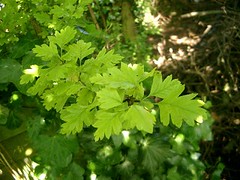
Here's more of the view from my window at work. The ash trees are still looking particularly green, regardless of the yellow and brown tinges. This is more evidence to show the protective value of the urban microclimate. These trees still have plenty of leaves, protected as they are by a slope and surrounding houses. Compare with the virtually leafless ash trees on the eastern edge of the Leeds conurbation.
This sketch cheers me up because, despite grey skies, some of the colours are almost spring-like, courtesy of school's nice, bright coloured pencils
Tuesday, November 15, 2005


Saturday, November 12, 2005
Flower Show
I saw just 3 minutes of 'Autumnwatch', the other day, this is the BBC's programme charting the progress of autumn. I would have watched the rest but a hungry child waits for no-man, certainly not Bill Oddie (the programme's presenter), so I went and made Nathan's tea instead. Nevertheless, I did hear Bill say that this autumn had come early and had been a long, mild one. This certainly matches with my observations. Back in an earlier post, I mentioned the early onset of the season. This week, the unusual length and mildness of this autumn really struck me. To be more precise 'flowers' struck me, or their presence did.
There isn't huge profusions of flowers, but they are there. I expect to see a few dahlias and the solanum always manages a good show well into November. What about gazania, delphinium, impatiens, red clover and gorse though? All still in flower as we near November's third week. I've never known a year like it. Is it global warming? Is it just a warm autumn, due to chance? Maybe it's down to the protection afforded by the microclimates of towns and villages hereabouts.
I hope it's just part of the wonderful seaonal variation that we get in Britain. The variation and lack of extremes that makes me so glad to live in this temperate little corner of the world. I'll stop there, before I start singing 'Jerusalem'.

There isn't huge profusions of flowers, but they are there. I expect to see a few dahlias and the solanum always manages a good show well into November. What about gazania, delphinium, impatiens, red clover and gorse though? All still in flower as we near November's third week. I've never known a year like it. Is it global warming? Is it just a warm autumn, due to chance? Maybe it's down to the protection afforded by the microclimates of towns and villages hereabouts.
I hope it's just part of the wonderful seaonal variation that we get in Britain. The variation and lack of extremes that makes me so glad to live in this temperate little corner of the world. I'll stop there, before I start singing 'Jerusalem'.
Sunday, November 06, 2005
Counting kestrels
Counting kestrels is one of my favourite in-car pastimes. Obviously you need to keep your eyes on the road but kestrels have the decency to hover over motorway verges and to sit on top of street lamps, making it a much safer hobby.
I once read a letter in a wildlife magazine from a bloke who claimed to have driven from Devon to Scotland and only saw one kestrel all journey. He cited this as evidence that kestrels were struggling. All birds need all the help and attention they can get but I think he was either a poor kestrel spotter or a very conscientious driver. My record count for a single journey is four, over the eleven miles to work. He should have driven through Leeds.
This is the female of the pair that holds territory at the end of the road, where the housing borders onto open fields. She was sat on the lamp-post this morning, presumably looking for a meal to scurry by.

I once read a letter in a wildlife magazine from a bloke who claimed to have driven from Devon to Scotland and only saw one kestrel all journey. He cited this as evidence that kestrels were struggling. All birds need all the help and attention they can get but I think he was either a poor kestrel spotter or a very conscientious driver. My record count for a single journey is four, over the eleven miles to work. He should have driven through Leeds.
This is the female of the pair that holds territory at the end of the road, where the housing borders onto open fields. She was sat on the lamp-post this morning, presumably looking for a meal to scurry by.
Tuesday, November 01, 2005
The Lime Avenue
We went to Thorp Perrow Arboretum at the weekend. I can’t recommend a visit to an arboretum highly enough, especially at this time of year. I love the autumn colour as I’ve said before, and the lack of strong winds in these parts so far, has left the leaves to colour up nicely.
Richard Bell describes it brilliantly, and so much better than I ever could, “there's autumn colour around, especially in the ashes, rowans and horse chestnuts, which glow as if they'd been illuminated from within but there's also plenty of dull drab green - the colour of waxed jackets and hiking trousers.” (Click here to see the full entry with illustrations.)
You can add ‘lime trees’ to that quote. The sketch is my impression of the Lime Avenue, an impressive stand of mature lime trees, spectacular and stately in the watery sunshine of late October.

Richard Bell describes it brilliantly, and so much better than I ever could, “there's autumn colour around, especially in the ashes, rowans and horse chestnuts, which glow as if they'd been illuminated from within but there's also plenty of dull drab green - the colour of waxed jackets and hiking trousers.” (Click here to see the full entry with illustrations.)
You can add ‘lime trees’ to that quote. The sketch is my impression of the Lime Avenue, an impressive stand of mature lime trees, spectacular and stately in the watery sunshine of late October.
Tuesday, October 25, 2005
The Alternative Bird Garden
We went to Lotherton Hall & Bird Gardens at the weekend, between the downpours. Whatever your opinions on captive animals, I feel that animal collections serve at least two good purposes. Firstly, all of the ones I’ve been to are involved in captive breeding programs for some of the world’s rarest animals, usually rare because of human activity. Secondly, it’s very hard to care for something that you’ve never experienced, so these places allow people, especially the young, to see animals close to. Some collections do it well, others less so. Lotherton doesn’t do it badly at all, with breeding programs, an education centre, frequent enclosure improvements and it’s free to get in.
After all that, we didn’t go to the bird garden today, we visited the adjoining deer park and went around the formal gardens. The red deer are well into their rutting season, with four impressively armoured males laying claim to a small territory, each one apparently centred on one of the equally impressive oak trees that abound in the deer park. With the sound of bellowing stags and a hint of mist in the air, we could have been in a highland glen rather than a half hour drive from Leeds city centre (you just had to put the distant cries of the whooping cranes, from the bird garden, out of your mind). You can certainly see why Landseer was so inspired by the stag.
In the formal gardens, the least contrived wildlife spectacle was in full flow – migration. Redwing were streaming over, there must have been four to five hundred, dropping into the trees to feed. This thrush is one of my favourite winter visitors, they arrive from Scandinavia in large numbers. The redwing joined good numbers of titmice, starlings and a single siskin. In the surrounding fields, there were an equally good number of fieldfare – another Scandinavian migrant thrush. All were feeding like their lives depended on it, which they probably do. So maybe we did go to the bird garden after all.

After all that, we didn’t go to the bird garden today, we visited the adjoining deer park and went around the formal gardens. The red deer are well into their rutting season, with four impressively armoured males laying claim to a small territory, each one apparently centred on one of the equally impressive oak trees that abound in the deer park. With the sound of bellowing stags and a hint of mist in the air, we could have been in a highland glen rather than a half hour drive from Leeds city centre (you just had to put the distant cries of the whooping cranes, from the bird garden, out of your mind). You can certainly see why Landseer was so inspired by the stag.
In the formal gardens, the least contrived wildlife spectacle was in full flow – migration. Redwing were streaming over, there must have been four to five hundred, dropping into the trees to feed. This thrush is one of my favourite winter visitors, they arrive from Scandinavia in large numbers. The redwing joined good numbers of titmice, starlings and a single siskin. In the surrounding fields, there were an equally good number of fieldfare – another Scandinavian migrant thrush. All were feeding like their lives depended on it, which they probably do. So maybe we did go to the bird garden after all.
Tuesday, October 18, 2005
Who's laughing now?
Twitching is like eating chips, I know its wrong but I still like it once in a while. Twitching is chasing after rare birds that someone else has found, it's more of a lazy sport than anything to do with nature so I try to limit my twitching to local rarities. This has lead to me spending lots of the last week trying to see a Laughing gull that's been hanging around the Pontefract and Featherstone area. Well, the bird's laughing - at me, and I should think any north american readers are laughing - because it's probably very common over there.
I finally caught up with the gull yesterday evening, got the adrenaline rush, watched it for half an hour then went home for tea. I was very happy.
The other upside to this tale is that I've basically spent a week watching flocks of common and black-headed gulls. I've improved my skills, I know common and black-headed gulls in all variations of winter plumage, and from all angles, in flight and on the ground (not that you'd know it from my sketch, perhaps). I've spent more time than I normally would simply being closer to nature. There are worse ways to spend your time.

I finally caught up with the gull yesterday evening, got the adrenaline rush, watched it for half an hour then went home for tea. I was very happy.
The other upside to this tale is that I've basically spent a week watching flocks of common and black-headed gulls. I've improved my skills, I know common and black-headed gulls in all variations of winter plumage, and from all angles, in flight and on the ground (not that you'd know it from my sketch, perhaps). I've spent more time than I normally would simply being closer to nature. There are worse ways to spend your time.
Tuesday, October 11, 2005
The Therapeutic Jungle
In the book ‘The Therapeutic Garden’ by Donald Norfolk, the author tells of the many beneficial effects of gardens, gardening and of just being within sight of plant life. This sketch shows some of the plants I keep in my classroom, drawn in biro whilst the class did a test. Kept for no other reason than they're good for the soul and I love ‘em. Its tough love though, I’m afraid. I tell myself that forgetting to water and feed the plants is just a form of natural selection, survival of the fittest, and that as Alan Titchmarsh once pointed out, an underwatered plant can always be saved but an overwatered one is lost. Good job too.
On more natural matters, the trees (outside!) are starting to colour up nicely, with definite tinges of gold and rust beginning to appear. This seems quite early to me, I just hope we don’t get any strong winds for a few weeks so we get to see the colours develop. Maybe the colour coming early will give it a better chance before the autumn winds really get started. It bodes well at present.
Talking about plants and jungles, congrats to Castleford Tigers Rugby League, for roaring back to the Super League, through the play-offs on Sunday. Sorry for the awful pun and the tenuous link (the Tigers play at ‘The Jungle’, although it’s still Wheldon Road to me).

On more natural matters, the trees (outside!) are starting to colour up nicely, with definite tinges of gold and rust beginning to appear. This seems quite early to me, I just hope we don’t get any strong winds for a few weeks so we get to see the colours develop. Maybe the colour coming early will give it a better chance before the autumn winds really get started. It bodes well at present.
Talking about plants and jungles, congrats to Castleford Tigers Rugby League, for roaring back to the Super League, through the play-offs on Sunday. Sorry for the awful pun and the tenuous link (the Tigers play at ‘The Jungle’, although it’s still Wheldon Road to me).
Subscribe to:
Posts (Atom)